Research Summary Paper
Infatuation, Attachment, and Cognitive Control: A Research Summary
The Author · Oct 13 · Research on a 2020 study

Purpose
Langeslag and van Steenbergen (2020) studied the relationship between infatuation/attachment and cognitive control with three measures (interference control, conflict adaptation, and post-error slowing). Interference control is defined as the ability to ignore distracting information and focus on the information relevant to a task. Conflict adaptation is the tendency for interference to shrink on a trial that follows a “conflict trial”, meaning people focus better right after they have just dealt with conflicting information. Post-error slowing is defined as the tendency to respond more slowly after making a mistake, allowing more time to avoid making another error. The purpose of the study was to determine whether stronger feelings of infatuation or attachment were associated with reduced interference control and whether attachment was associated with conflict adaptation and post-error slowing. In simpler terms, the researchers attempted to discover whether infatuation or attachment was associated with them having less focus, a lower ability to adjust to conflicting information, or a difficulty in changing responses after making a mistake.
The authors discussed several important findings from other previous research in the introduction of the paper. First, romantic love has been associated with physiological changes including a pounding heart, along with emotional changes like anxiety or euphoria (intense feelings of joy). Second, there are associations with cognitive changes such as increased attention to or memory for information regarding a romantic partner. Third, cognitive control can be influenced by emotional factors. These factors can include rewards, humor, arousal, mood, and motivation. Fourth, a previous study found that stronger romantic love was associated with reduced interference control after participants went through a procedure that was designed specifically to intensify their romantic feelings. Fifth, previous research suggested that positive states of emotion could reduce conflict adaptation while negative states could increase it. Finally, romantic attachment has been associated with positive emotions, feelings of security, and protection against stressful or painful experiences. Based on those previous findings, Langeslag and van Steenbergen (2020) investigated the relationship between infatuation and attachment and interference control, and attachment’s association with conflict adaptation and post-error slowing. Their research aimed to clarify how different aspects of romantic love relate to the ability to ignore distractions, adapt to conflicting information and respond after mistakes.
Methods
The researchers initially used 103 young adults who reported being in love. They did have to exclude 20 participants due to technical problems, extreme results, being in love longer than 9 months and other disqualifying factors and the final sample ended up being 83 participants between 17 and 27 years old. Participants completed a computer-based Stroop task to measure interference control and adaptive cognitive control. The details of the task were that participants viewed direction words such as “Left” or “Up” and had to identify the target word as quickly and accurately as possible while ignoring some other potentially distracting words. There were congruent trials where the distractor matched the target word and incongruent ones where the distractor was different which slowed participants down. The researchers measured response times and accuracy to determine how participants responded to conflicting information, adjusted their responses after conflict, and changed their response speed after making errors. Participants also completed the Infatuation and Attachment Scales (IAS), a questionnaire with 10 items measuring infatuation and 10 items measuring attachment. Each item was rated on a seven point scale with higher scores indicating stronger feelings. The researchers used statistical analysis including correlation coefficients, to examine relationships between infatuation, attachment, and cognitive control. This was a correlational study because the researchers measured the participants' existing romantic feelings rather than trying to manipulate them. The session lasted around 20 minutes (Langeslag & van Steenbergen, 2020).
Main Finding, Discussion, Conclusion
Langeslag and van Steenbergen (2020) found that romantic infatuation and attachment were not significantly associated with interference control. In shorter terms, participants with strong romantic feelings did not show significantly better or worse abilities to ignore distracting information. The researchers suggested that romantic love might interfere with concentration mainly when people are actively thinking about their partners. The study also found weak evidence of a negative relationship between attachment and conflict adaptation (r = -.214, p = .052). While this result followed the predicted direction, it did not reach the threshold for statistical significance. The results did not establish a significant relationship between attachment and conflict adaptation. However, attachment was significantly negatively correlated with post-error slowing ( r = -.220, p = .045). Post-error slowing is defined as the tendency to respond more slowly after making a mistake. This finding suggests that participants who reported stronger attachment to their romantic partners tended to slow down less after making errors. In conclusion, the researchers found that attachment was correlated with reduced post-error slowing, while the predicted relationships involving interference control and conflict adaptation were not statistically significant.
The study had several limitations. First, the final sample consisted of only 83 young adults who had recently fallen in love, meaning the findings may not apply to older adults or people in longer relationships. Second, because the study was correlational, the researchers could not establish that romantic attachment directly caused changes in cognitive control, because correlation is NOT causation. Third and while not mentioned by the authors but what I personally believe is a point of weakness, the study did not directly measure neurochemicals such as dopamine, oxytocin, or cortisol, so it cannot establish how these biological substances might relate to the findings. Nevertheless, this research is important because it helps explain how different aspects of romantic love may relate to attention and behavioral adjustment. Although infatuation and attachment were not significantly correlated with interference control, attachment was associated with reduced post-error slowing. This finding may help researchers understand how emotional bonds relate to responses to mistakes and stressful experiences. The authors suggested that attachment might reduce the negative emotional impact of certain events, which could help explain why strongly attached individuals slowed down less after making mistakes. Further research is needed to determine the mechanisms behind this relationship and whether it influences everyday function.
References Langeslag, S. J. E., & van Steenbergen, H. (2020). Cognitive control in romantic love: The roles of infatuation and attachment in interference and adaptive cognitive control. Cognition and Emotion, 34(3), 596–603. https://doi.org/10.1080/02699931.2019.1627291
Infatuation and attachment are different constructs
Infatuation describes intense romantic preoccupation and can include euphoria, anxiety, and nervousness. Attachment describes a comforting emotional bond associated with security and calmness. This study measured them separately rather than treating romantic love as one score. The IAS scores were not correlated, r(81) = −.037, p = .739; this supports their distinction in this sample, not a universal claim that they are independent.
Who participated—and who did not
The researchers recruited 103 self-described young adults in love. Twenty were excluded for one or more reasons: feelings lasting longer than nine months (12), technical data loss (1), no errors from which to calculate post-error measures (4), or extreme accuracy outliers (1 interference; 5 post-error). These counts overlap and should not be added as if they represent separate people. The final sample was 83 people aged 17–27, mean age 21.5, including 37 men. Stated recruitment criteria included age 18–28, native Dutch language, no psychiatric history, and no color blindness; the reported final age range nevertheless included 17. Participants gave written consent, and the study had ethics approval.
Fifty participants were in a relationship with the person they loved and 33 were not. Mean duration of romantic feelings was 3.8 months (range 0–9); mean relationship duration was 3.6 months among those in relationships. Mean infatuation score was 32.5 (range 14–59) and attachment score 52.5 (range 20–70). The sample was selected for recent romantic love, not for autism or the general population.
Inside the Stroop-like task
Each trial presented three identical distractor direction words for 133 ms, a blank screen for 33 ms, then one target direction word for 133 ms, followed by a 1,700 ms blank interval. Participants identified the target with keyboard keys F, G, J, or N as quickly and accurately as possible. Responses were timed from target onset; missing a response within 1,500 ms counted as an omission. Error feedback lasted 200 ms. Left–Right and Up–Down tasks alternated to avoid consecutive stimulus and response repetitions, and distractor–target pairings occurred equally often to reduce contingency learning.
There were 24 practice trials, repeated when accuracy was below 80%, followed by two blocks of 96 test trials. Afterward participants completed two 10-item IAS scales, each rated from 1 to 7, yielding scores from 10 to 70. Internal consistency in this sample was Cronbach’s alpha .85 for infatuation and .91 for attachment. The entire session lasted about 20 minutes. Unlike the earlier study, there was no love-boosting writing-and-music procedure.
How the cognitive-control measures were calculated
Response-time interference = mean RT on incongruent trials minus mean RT on congruent trials. Lower interference means less distraction. Conflict adaptation = (cI − cC) − (iI − iC), where lowercase letters indicate the previous trial and uppercase letters the current trial, C means congruent and I incongruent. Larger positive values indicate that interference shrank after conflict. Accuracy differences used the reverse subtraction direction so their interpretation matched the authors’ scoring.
Post-error slowing compared correct trials immediately before and after an error: mean post-error RT minus mean pre-error RT. This triplet method reduces confounding by slower changes in attention or motivation across the session. Post-error accuracy was post-error minus post-correct accuracy. For interference and conflict RT analyses, the first trial of each block, incorrect trials, trials following errors, and participant-specific RT outliers beyond 2.5 standard deviations were excluded. The post-error analysis necessarily used its own error-centered trial selection.
Numerical results—not just the headline
The task produced the expected effects: RT interference t(82) = 19.2, p < .001; accuracy interference t(82) = 6.1, p < .001; RT conflict adaptation t(82) = 4.2, p < .001; accuracy conflict adaptation t(82) = 2.2, p = .031; post-error slowing t(82) = 7.5, p < .001; and post-error accuracy t(82) = 4.9, p < .001. These task effects show the measures worked in this sample; they are not evidence of a love–control association.
Interference was unrelated to infatuation, r(81) = −.018, p = .872, or attachment, r(81) = .028, p = .798. Infatuation also was not significantly related to conflict adaptation, r(81) = −.116, p = .297, or post-error slowing, r(81) = −.038, p = .730. Attachment was not related to post-error accuracy, r(81) = −.056, p = .616. The authors suggested a floor effect because errors after other errors were uncommon (3.6%).
Attachment–conflict adaptation: r = -0.214, p = 0.052. This did not meet the two-sided .05 significance threshold. Attachment–post-error slowing: r = -0.22, p = 0.045. This was a small negative correlation meeting that threshold. Squaring these correlations gives approximately 4.6% and 4.8% shared variance, respectively; neither means that attachment caused a change in performance.
The original scatterplots
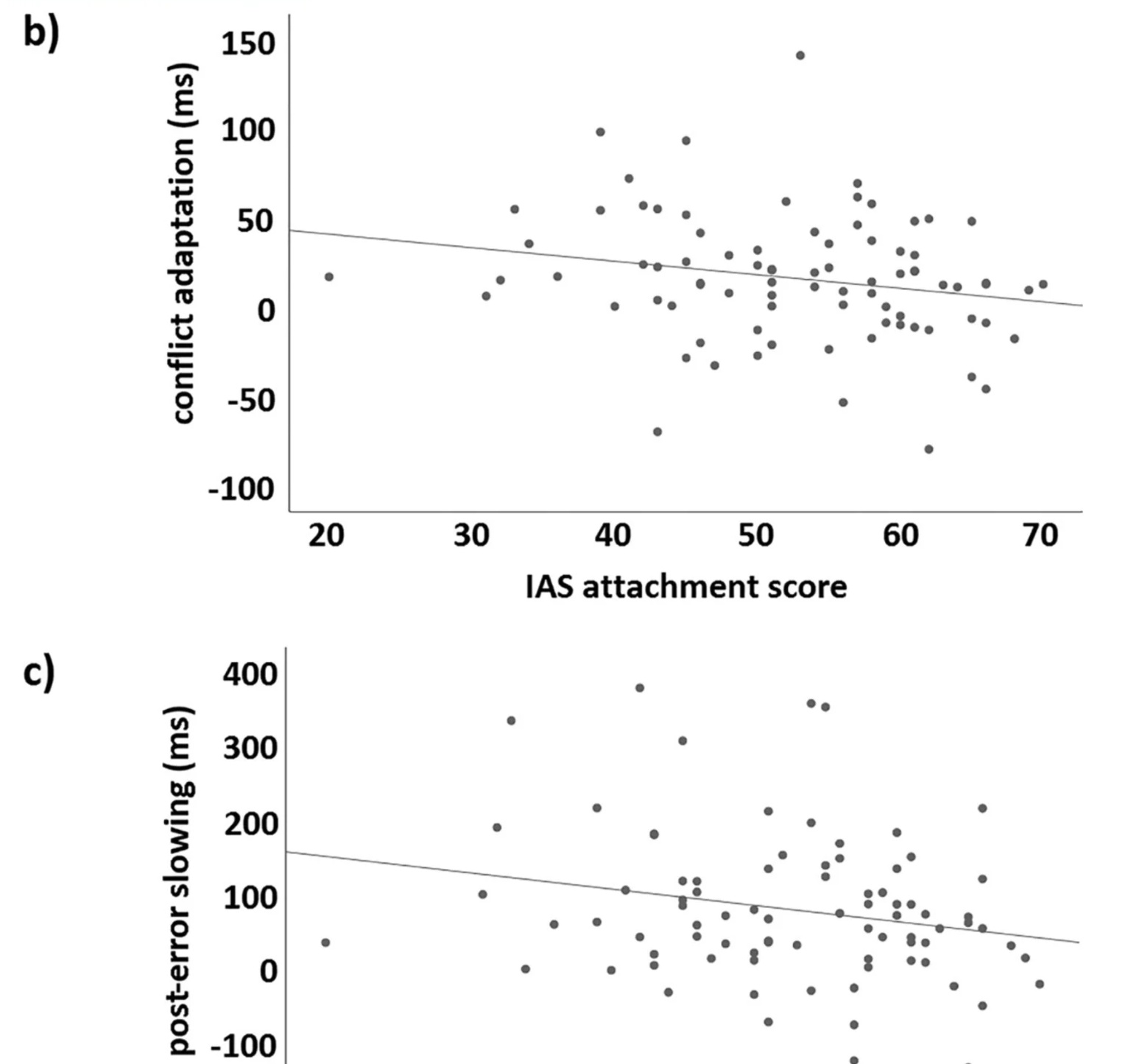
Interpretation, uncertainty, and biological hypotheses
The authors proposed that positive affect or buffering against aversive events might reduce the impact of errors, and discussed endogenous opioids as a possible mechanism based on other research. They did not measure opioids, dopamine, oxytocin, brain activity, or emotional responses to individual errors here. These mechanisms remain hypotheses, not findings of this experiment.
A power analysis estimated 85% power to detect the earlier study’s r = .318 at two-sided alpha .05, not 85% power to detect every smaller association. Different questionnaires and the absence of a love booster may help explain the non-replication, but this study did not experimentally isolate those explanations. Several correlations were tested, and the significant p = .045 is close to the threshold; its interpretation should be cautious. A null result is not proof that no relationship exists, and a threshold-crossing result is not proof of a mechanism or an everyday impairment.
Research context
This paper studied romantic love in young adults, not autism. It should not be treated as evidence that autistic people have reduced cognitive control. The reported relationships are correlations, not proof of cause and effect.
Sources and further reading
- Langeslag & van Steenbergen (2020) — Cognitive control in romantic love
Original paper in Cognition and Emotion, 34(3), 596–603. The incomplete DOI in the supplied summary has been completed here.
This is a student-written research summary, not an original experiment or medical advice.