Essay
Autism and Sensory Overload: Why a Loud Cafeteria Can Feel Like an Emergency
The Author · Sep 26 · 12 min read
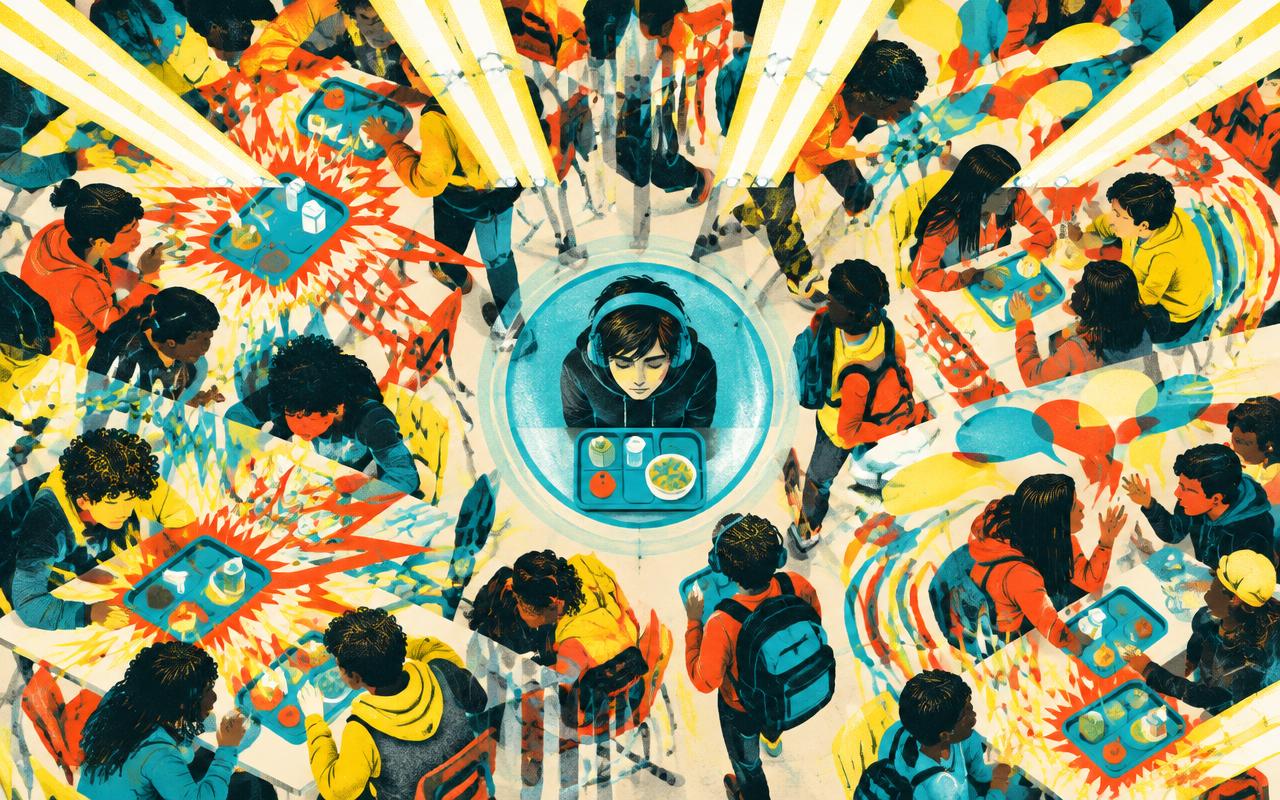
People love to say autistic kids are “dramatic” about noise, “picky” about clothes, or “too sensitive” about lights. What almost nobody says out loud is that for a lot of us, a loud cafeteria is not just annoying. It can feel like an actual threat—the kind of thing your body reacts to before your brain has a chance to say, “Relax, it's just lunch.” This is why that happens, using ideas many of us learned in AP Psych without ever connecting them to ourselves.
What the Research Shows
Sensory differences are common enough that they are part of the diagnostic criteria for autism in the DSM-5, under unusual reactions to sensory input. Many autistic people are over-responsive to some things, such as sounds, textures, or bright lights, and under-responsive to others. Some are both, depending on the day.
Here is the AP Psych version of what might be going on. Your senses send information to the thalamus, which acts like a relay station and passes signals to the cortex. Normally the brain also uses sensory gating to filter out things that do not matter, like the hum of a fridge or the feeling of your socks. Some research suggests that this filtering works differently in autistic brains, so more incoming information gets through at full volume.
One idea that tries to explain this is the Intense World Theory, proposed by neuroscientists Kamila and Henry Markram. It suggests that parts of the autistic brain may be hyper-reactive, so the world is not too little for us—it is too much, too loud, and too intense. A related idea involves the excitation and inhibition balance. Neurons communicate using glutamate, which excites them, and GABA, which calms or inhibits them. Some researchers think autism may involve a shift in that balance, so the brain is more turned up than it should be. This is still a theory being researched, not a settled fact, and it probably does not explain every autistic person.
Then there is the amygdala, the brain's alarm system. When it decides something is dangerous, it triggers the sympathetic nervous system—the fight-or-flight response. Your heart rate rises, your muscles tense, and your body floods with stress hormones. The amygdala is not very good at telling the difference between a real threat and a fire alarm that is simply very loud. When sensory input becomes overwhelming, your body can respond as if it is in danger even when you are safe.
Why It Feels Different
It is physical before it is emotional. By the time someone notices a student getting upset, their body has often been in alarm mode for a while. It is not a mood or an attitude; it is a nervous system response.
You cannot “just ignore it.” Ignoring something relies on your brain filtering it out, and filtering is the exact process that may work differently. Telling someone to ignore a sound they physically cannot tune out is like telling someone to ignore a mosquito in their ear.
It builds over the day. Every noisy hallway and flickering light uses energy. By sixth period, an autistic student may have almost nothing left. That is why the same person can seem fine in first period and completely fried by the afternoon.
Masking makes it worse. Sitting through overwhelming input while pretending you are fine keeps the stress response running the whole time, and that is exhausting on its own.
The Different Shapes This Can Take
The meltdown. When overload passes a certain point, the body basically takes over. It can look like crying, yelling, or losing control, and it is not a choice or a tantrum.
The shutdown. Sometimes the response goes inward. Speech becomes harder, the person goes quiet, and they may look checked out when they are really overloaded.
The avoidance. Skipping the cafeteria, wearing headphones, or avoiding certain classrooms can look antisocial, but it is often a way of managing sensory input.
The seeking. Some autistic people are under-responsive and crave extra input, such as spinning, pressure, or loud music. It is the same sensory system at a different setting.
A Note From a Friend
Sophomore year, there was a fire drill in the middle of a chemistry test. I knew it could happen because we had drills before, but this time the alarm went off while I was in the middle of a problem and the whole room went white and loud. I could not think. My heart was pounding, my hands were shaking, and I walked out with everyone else feeling like I was about to throw up. When we came back, my teacher said, “It was just a drill, you're fine,” and I did not know how to explain that my body had not gotten the memo. I got a bad grade on that test. A few months later in AP Psych, we learned about the amygdala and fight-or-flight, and I remember thinking, Wait, that is exactly what happened to me. It did not make loud noises stop bothering me, but it helped to know I was not weak or overreacting.
Where People Get Stuck
Overload gets treated as a behavior problem when it is a nervous system response. People assume that if a student handled a loud room yesterday, they should handle it today, even though tolerance changes with sleep, stress, and how much input has already built up. “You're being too sensitive” suggests that sensitivity is a choice. Accommodations like headphones or a quiet room get treated as special treatment, when they are closer to glasses for someone who cannot see the board.
What Helps
Reduce the input where you can. Noise-reducing headphones, sunglasses, or a different seat can lower the sensory load before it reaches the alarm point.
Build in recovery time. A few minutes in a quiet space between classes can help reset your nervous system before the next round.
Learn your early warning signs. Many people notice small signals before full overload, such as a tight chest, irritability, or trouble following a conversation. Catching those signals early gives you time to step out.
Use calming strategies that work for your body. Slow breathing activates the parasympathetic nervous system, the rest-and-digest side that counterbalances fight-or-flight. It will not fix everything, but it can help bring the body back down.
Separate the reaction from the character. Knowing that your response is physiological does not make the noise quieter, but it can stop you from adding shame on top of the overload.
A Word on Boundaries
None of this means a student should never be asked to handle anything uncomfortable. Learning to cope with some sensory experiences is part of life. The goal should be helping someone cope in a way that works for their nervous system, not forcing them to endure what hurts and calling it growth.
A Note for Teachers and Parents
If a student seems to overreact to noise, light, or crowds, it may be a genuine sensory difference and not an attitude problem. Small changes such as a quieter place to take a test, advance warning before a fire drill, or permission to step out for a minute can make a huge difference, and they usually cost almost nothing.
Sources and further reading
- The Intense World Theory—a unifying theory of the neurobiology of autism
Kamila Markram and Henry Markram propose a framework of heightened reactivity and plasticity in autism.
- Sensory processing in autism: a review of neurophysiologic findings
Marco and colleagues review evidence about sensory processing differences in autism.
- Model of autism: increased ratio of excitation/inhibition in key neural systems
Rubenstein and Merzenich's original proposal about excitation and inhibition in autism.
- Autistic Self Advocacy Network
Autistic-led resources on education, accommodations, and self-advocacy.
Being overwhelmed by the world is not a flaw in the person. Sometimes the most important step is understanding what the nervous system is doing, then adjusting the environment to match.